
Your camera takes great pictures: One of the least favorite phrases any photographer wants to hear. It implies that somehow the photographer’s camera has auto-magically created an amazingly composed, stunning photograph without any human intervention or skill whatsoever. But wait. There is a camera like that, and most people own one! It’s called your eyes. Our human eyes are controlled by a set of amazingly sophisticated, finely tuned, and very delicate set of controls that acclimatize to different lighting conditions.
As one dives deeper into understanding light, it’s hard not to chuckle at the mere thought of all these things accidentally happening by random chance. I mean, I don’t want to offend people who think that the world just evolved from a fluke set of coincidences. But as you dig into the science of it all, the sheer amount of evidence pointing to intelligent design is impossible to ignore. Dare I say that you’d have to have your eyes closed not to see it?
So how complex and wonderfully created are our eyes? Let me give you a tiny glimpse as to what it takes for you to see anything.
To even entertain the possibility of physical sight, light needs to reach your retina, a thin layer of tissue that resides on the back of your eye near your optic nerve. The retina’s responsibility is to take the light from your eye lens, translate it into neural signals, and then fire it off to the brain (which is a whole other insanely complex matter). We could just stop there and say, “yeah right, there’s no way that’s possible,” but it is! So, let’s just take a small snapshot of what needs to happen for you to be able to see.
To begin, the amount of light that enters each one of your eyes needs to be measured and controlled. Think of an over-exposed or under-exposed photo—too much light, and you can’t make out anything; too little light, and you’re facing the same problem.
Secondly, the subject needs to be sharp and in focus for the brain to understand what the heck is going on.
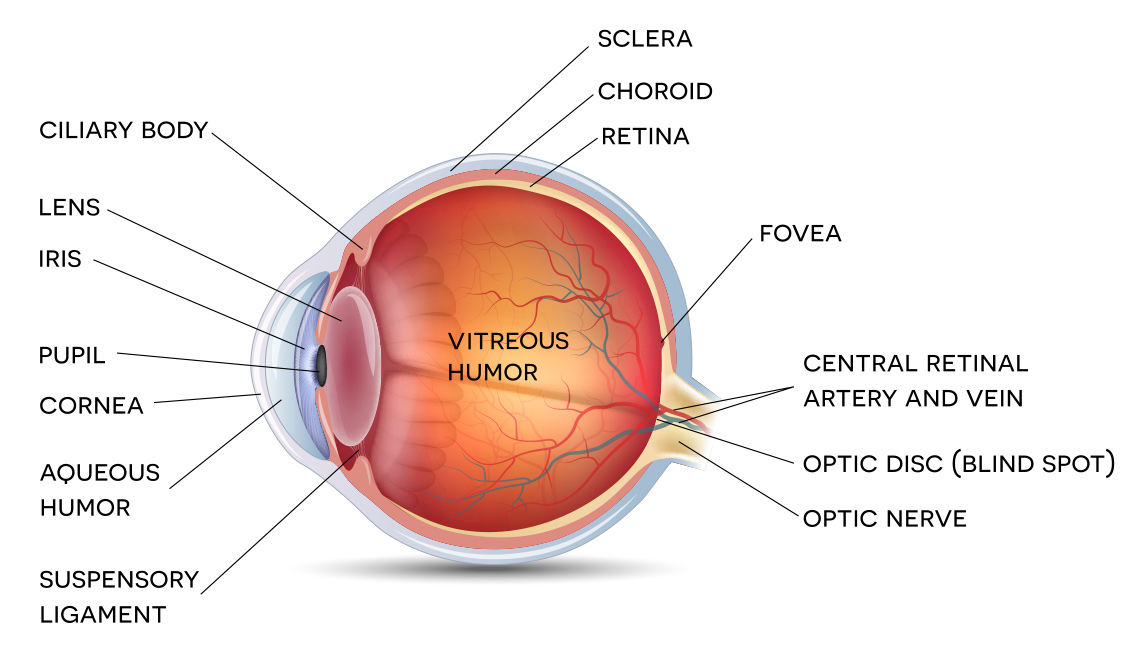 Starting at the front of your eyes, we have the cornea, an advanced, transparent tissue that helps bend light into focus. Next, we’ve got a clear fluid called aqueous humor, which also helps bring light into focus. Following that, we have the iris (responsible for your eye’s coloring) and the pupil, sitting virtually in line with the cornea. Like the camera aperture when you take a photo, the iris (which, in Greek, means “rainbow”—think the visible-light spectrum we already discussed) controls how much light enters the eye by automatically widening and narrowing the pupil.
"Wait, what? Are you kidding me?"
Nope. The best Inventor in the universe invented the best, most beautiful camera in the world.
Continuing along, as light passes through the cornea, aqueous humor, and pupil, it finally reaches the lens, which, based on how the brain interprets it, makes the fine adjustments for near and distant focusing. Finally, the light flows through the vitreous humor (a jelly-like substance) and reaches the retina, en route to your brain. Unbelievable, right?! If that’s not enough, there’s another player here—the muscles in your eyeballs move them up, down, left, and right to allow you to look precisely at what you want to see. You can’t make this stuff up.
If one of these things—the cornea, the pupil, the aqueous humor, the iris, or other numerous parts of the eye—isn’t functioning, you can’t see. It’s really that simple.
On top of that, having two eyes allows us to see with binocular vision, providing us with amazing depth perception. As an example, you wouldn’t want to thread a needle with one eye open and one eye closed; it would end badly because your perception of depth and location requires two eyes to function properly.
That photographer’s camera you thought took amazing, auto-magical pictures is like a child’s toy compared to what God has designed in our eyes. To Him be the glory.
For this people’s heart has grown dull, and with their ears they can barely hear, and their eyes they have closed, lest they should see with their eyes and hear with their ears and understand with their heart and turn, and I would heal them. (Matthew 13:15)
 Eyes of Hope
Every morning, I send an email featuring photos that I've taken from around the world, along with a Scripture verse. If you'd like to receive these emails, please enter your information below.
 unOblivious
 Do we see the amazing beauty in the things that God has created, the people He's brought into our lives, the situations He's put us in? Or do we live in a bubble, oblivious to His amazing wonder happening all around us? unOblivious is a 160-page photo-essay that helps answer that question.
